Angle Grinder Spindle Fitment Guide: 5/8"-11, M14, M10 Threads, Removable Flanges & Adapters
If your wheel will not thread onto the grinder, stop forcing it. The angle grinder spindle thread size must match the wheel or threaded flange: 5/8"-11 is common on North American grinders, while M14 and M10 are metric thread systems found on other machines and markets. A proper adapter can bridge some combinations, but only when the thread, shoulder, flange seating, and wheel clearance all line up correctly.
I’ve seen good diamond wheels blamed for bad cuts when the real problem was sitting dead center in the grinder: the fitment was wrong. Somebody bought a wheel online, saw “4-1/2 inch,” figured that meant it fit every 4-1/2-inch grinder, and cranked an adapter onto the spindle until everything looked tight. Then the wheel chattered through porcelain, wandered on a granite edge, or vibrated hard enough to make the operator back off.
Wheel diameter does not tell you the spindle connection. Before you buy another disc—or blame the one already in your hand—identify the spindle thread and understand how the flange actually locates the wheel.
Why Angle Grinder Spindle Thread Size Matters More Than Most Guys Think
The first mistake is treating every connection at the center of a grinding wheel as an “arbor.” A plain-bore wheel, a threaded wheel, and a wheel mounted through a removable threaded flange are three different setups.
A 5/8"-11 spindle is an imperial thread: nominally 5/8 inch in diameter with 11 threads per inch. M14 and M10 are metric thread families. They are not interchangeable just because two threaded parts look close enough across a dirty workbench. 5 8 11 vs M14 arbor compatibility is especially dangerous to eyeball because “almost fits” is exactly what you do not want on a high-speed rotating accessory.
The second problem is how the wheel seats. Threads hold the assembly on the spindle, but stable rotation also depends on the mating surfaces being clean, square, concentric, and properly seated. Dirt behind a flange, damaged threads, a poorly made adapter, or a flange that bottoms out incorrectly can introduce runout. At speed, a small alignment error at the hub becomes visible movement at the outside edge.
That movement becomes chatter. Chatter turns into chipped tile, wandering cuts, uneven bevels, extra finishing work, and a tired operator trying to correct the grinder instead of letting the abrasive do its job.
This is where cheap grinder thread adapter compatibility becomes expensive. A bargain adapter that adds wobble may cost less at checkout, but the contractor pays for it in ruined material and labor. Before mixing wheels, adapters, and grinders from different systems, start with the RedhawkPro angle grinder accessories collection and match the connection deliberately.
Angle Grinder Spindle Thread Size: 5/8"-11, M14 and M10 Explained
For North American contractors, 5/8"-11 is the thread you will run into constantly on compatible angle-grinder accessories. The “5/8” identifies nominal thread diameter and “11” means 11 threads per inch. M14 and M10 belong to the metric system; the number identifies the nominal thread diameter in millimeters, while the actual pitch still matters when confirming compatibility.
That last part is worth repeating: diameter alone is not enough.
If you are identifying an unknown grinder, unplug it or remove the battery, strip off the accessory, clean the spindle, and inspect the manufacturer markings and manual first. If those are unavailable, measure carefully with calipers and use a proper thread-pitch gauge. Do not identify a spindle by finding a nut that “sort of starts.”
The same discipline applies when using a threaded diamond wheel. The RedhawkPro 4-1/2" Turbo-Wave 2-in-1 Diamond Wheel is offered in 5/8"-11 and M14 configurations on the current 4-1/2-inch product page. The broader Turbo-Wave family also uses removable-flange designs and multiple thread configurations depending on wheel size and variant. Buy the connection for the grinder you actually own—not the one you assumed you owned.
The Engineered Fix: Match the Thread, Then Control the Interface
A proper setup starts with a wheel designed around the way professionals actually work. The RedhawkPro Turbo-Wave uses a rigid 65Mn spring-steel core, dual-sided electroplated diamond working surfaces, and a removable flange system. The flange matters here because it provides a defined mechanical interface between the wheel and compatible grinder spindle while allowing the wheel to be reversed when the configuration permits.
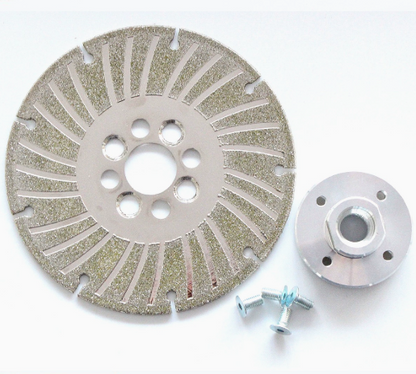
Figure 1: RedhawkPro Turbo-Wave diamond wheel with removable threaded flange—the spindle interface is a mechanical part of the cutting system, not an afterthought.
The Turbo-Wave face uses open channels through the working surface to help move grinding debris and manage heat buildup. Both sides carry electroplated diamond, so the wheel can handle cutting followed by edge grinding, shaping, or beveling without treating those operations like completely unrelated jobs.
But good engineering does not excuse sloppy installation. Inspect the spindle threads. Clean the flange and wheel mating surfaces. Make sure the selected thread configuration matches the grinder. Spin the mounted wheel by hand with the machine disconnected and verify that nothing interferes with the guard or grinder body.
Then run the grinder unloaded in a safe position before touching the workpiece. If you see obvious wobble or feel abnormal vibration, stop. Do not “cut through it.”
During cutting, let the diamond do the work instead of leaning your body weight into the grinder. During grinding or beveling, use controlled contact rather than burying the wheel face into the material. Excessive pressure loads the grinder, builds unnecessary heat, and makes precise control harder. Follow the grinder and wheel manufacturers' rated speed limits; there is no magic universal RPM setting that replaces the specifications of the actual equipment in your hands.
Cooling is equally application-dependent. If your wheel, grinder, and work procedure permit wet operation, water can help manage heat and debris. If the setup is dry-only, do not improvise water around equipment that is not designed for it.
And remember: a flush cut diamond wheel arbor or removable-flange arrangement does not mean every grinder automatically gains true flush-cut capability. Guard clearance, spindle projection, flange geometry, wheel construction, and the grinder manufacturer's instructions still control what is safe.
Jobsite Decision Table
| Dimension | Old/Standard Method | RedhawkPro Engineered Approach |
|---|---|---|
| Cut Speed | Wrong or improvised fitment can create chatter and force repeated corrections | Correct thread and stable flange seating help the wheel work as designed |
| Edge Quality | Runout can show up as wandering cuts, uneven bevels, and extra cleanup | Concentric mounting supports steadier cutting and controlled edge work |
| Tool Life | Excess pressure and poor alignment can accelerate unnecessary wear | Proper fitment and controlled pressure use the working surface more effectively |
| Safety/Risk | Forced threads, questionable adapters, and visible wobble add avoidable risk | Match spindle, thread, flange, guard clearance, and rated operating limits before use |
| Cost-Per-Cut | Cheap hardware can turn into wasted tile, labor, and downtime | Correct fitment reduces avoidable rework and unnecessary accessory changes |
Removable Flange Angle Grinder Setup: Three Rules I Don't Break
Rule one: never force a thread. If a 5/8"-11 component does not start correctly on the spindle, stop. Same goes for M14 or M10. Cross-threading a spindle or adapter is not a field modification; it is damaged hardware. If you genuinely need to convert between compatible systems, use a purpose-built angle grinder thread adapter and verify both sides of the connection before running the machine.
Rule two: chase runout before chasing the blade. When a new wheel suddenly “cuts crooked,” remove the battery or unplug the grinder and inspect the mounting stack. Check the spindle, flange faces, threads, trapped debris, and seating. A precision wheel mounted crooked is still a crooked rotating system.
Rule three: listen to the motor. A grinder that is constantly bogging down is telling you something. You may be pushing too hard, using the wrong abrasive for the material, or asking a poorly mounted wheel to fight its own vibration. Back off and find the cause. More pressure is not professional technique.
For more information about the company and the tooling philosophy behind these products, see About RedhawkPro Tools.
Stop Paying Twice for Cheap Fitment
A good diamond wheel on the wrong spindle setup is still the wrong setup. Identify your angle grinder spindle thread size, match the flange correctly, eliminate questionable adapters, and let the wheel run true. Cheap tooling and sloppy fitment do not save money when you pay for them again in labor.
Choose the correct RedhawkPro 4-1/2" Turbo-Wave Diamond Wheel configuration for your grinder.